






Seashells, Sandcastles, & Speech!
Expansion & Extension Strategies
Expansion: Repeat what your child says and add grammar to make the phrase fuller. (TIP: Use short, complete sentences.)
Extension: Add more information and details to help your child learn longer ideas.
Expansion Examples:
- Child: “candy” → Parent: “Mmm, it's a yummy candy.”
- Child: “roof” → Parent: “The roof is big.”
- Child: “house” → Parent: “It's a gingerbread house.”
- Child: “sticky” → Parent: “The frosting is sticky.”
Extension Examples:
- Child: “house cookie”
- Parent: “You want to build a big cookie house. Let’s build it.”
- Child: “candy on”
- Parent: “Yes! You’re putting candy on the roof to make it colorful.”
- Child: “door”
- Parent: “You want the door! Let’s put the red door on the front of the house.”
- Child: “sticky frosting”
- Parent: “The frosting is sticky because it helps the candy stay on.”
Language Enhancing Tips!
- Follow your child's lead.
- Talk about what you see, feel, and do.
- Repeat new words often.
- Pause (5-10 seconds) to give your child time to respond!
- Have fun!
Beach days are naturally filled with opportunities for conversation. Children are exploring new textures, hearing unfamiliar sounds, noticing movement, and sharing exciting experiences with family members. Instead of turning the day into a lesson, parents can use small moments throughout the trip to encourage communication in a fun and natural way.

Beach Day Language Ideas for Young Children
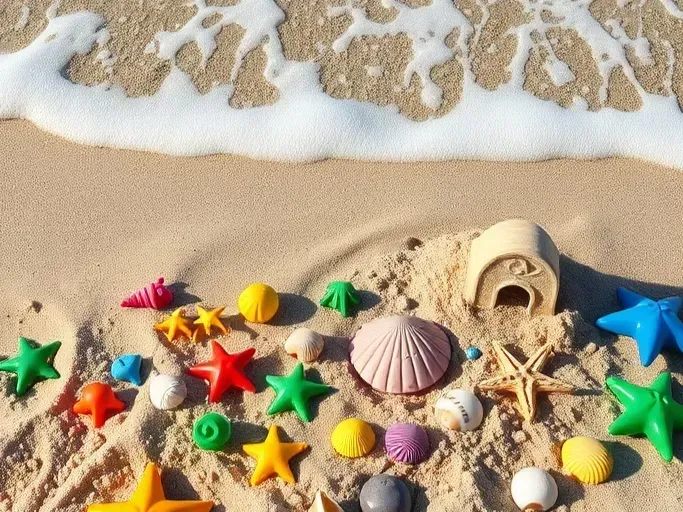
Turn Collecting Seashells into a Conversation Game
Walking along the sand and collecting shells is an easy way to encourage describing, comparing, and commenting.
You can say things like:
- “I found a tiny shell!”
- “This one is smooth.”
- “Your shell is bigger than mine!”
Children can also practice concepts like:
- colors
- counting
- big/small
- rough/smooth
This keeps language connected to what your child is actively seeing and touching.
Use Beach Toys for Pretend Play
Buckets, shovels, and sand molds can easily become part of imaginative play.
Pretend your child is:
- building a bakery
- making ice cream
- cooking dinner
- digging for treasure
Model phrases like:
- “Let’s make a giant cake!”
- “The treasure is hiding!”
- “Pour the sand in.”
Pretend play encourages creativity, sequencing, and expressive language without feeling structured.
Narrate the Environment Around You
The beach is full of sounds, movement, and sensory experiences that naturally support vocabulary development.
Point out things like:
- seagulls flying
- waves crashing
- people surfing
- kites moving in the wind
You can model:
- “The kite is flying high!”
- “I hear loud waves.”
- “The sand feels hot.”
Describing what your child sees and hears helps expose them to rich vocabulary in real-life situations.
Keep Language Simple & Repetitive
Children learn language best through repetition and shared experiences. During the beach trip, try:
- repeating fun phrases
- pausing to give your child time to respond
- using gestures along with words
- following your child’s interests during play
Simple, playful interactions throughout the day can create meaningful opportunities for communication growth.
Next Steps...
If you are concerned about your child's speech and language development - some of the next steps you can take include:
- contacting your child's pediatrician (ask for a referral for a speech and language evaluation)
- contacting your local regional center to see if your child could be assessed (0-3 years of age)
- contacting your local public school district to see if your child could be assessed (3+ years old)
- contacting a local speech therapy private practice that specializes in early language development
If you are interested in learning more about our speech and language therapy services and are local to Upland, California (Inland Empire), please contact us to today by completing our Contact form.