







Celebrating Valentine’s Day: Early Language Strategies for Young Children
Expansion & Extension Strategies
Expansion: Repeat what your child says and add grammar to make the phrase fuller. (TIP: Use short, complete sentences.)
Extension: Add more information and details to help your child learn longer ideas.
Expansion Examples:
- Child: “candy” → Parent: “Mmm, it's a yummy candy.”
- Child: “roof” → Parent: “The roof is big.”
- Child: “house” → Parent: “It's a gingerbread house.”
- Child: “sticky” → Parent: “The frosting is sticky.”
Extension Examples:
- Child: “house cookie”
- Parent: “You want to build a big cookie house. Let’s build it.”
- Child: “candy on”
- Parent: “Yes! You’re putting candy on the roof to make it colorful.”
- Child: “door”
- Parent: “You want the door! Let’s put the red door on the front of the house.”
- Child: “sticky frosting”
- Parent: “The frosting is sticky because it helps the candy stay on.”
Language Enhancing Tips!
- Follow your child's lead.
- Talk about what you see, feel, and do.
- Repeat new words often.
- Pause (5-10 seconds) to give your child time to respond!
- Have fun!
Valentine’s Day brings a whirlwind of hearts, colors, and affection; perfect for nurturing language in young children. In this post, we'll share strategies that go beyond simple naming, incorporating dynamic words to help your child express more fully during this loving season.

An Engaging Activity for Expanding Vocabulary (Ages 2-6): Valentine’s Sensory Book Creation
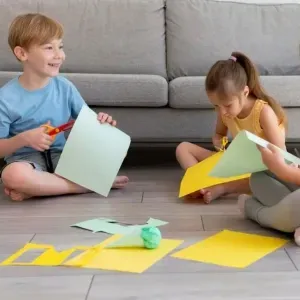
Turn Valentine’s Day into a vocabulary booster with a "Valentine’s Sensory Book Creation" activity—a hands-on craft that doubles as an interactive book. This encourages exploration of verbs (like "sticking," "sparkling") and adjectives (like "fuzzy," "sweet"), with visual support from textured materials and pictures.
What You'll Need:
- construction paper
- glue
- sensory items (feathers, glitter, fabric hearts)
- markers
- photos or printed images of Valentine’s elements
How to Do It:
- Start by flipping through a simple picture book about love or holidays for visual inspiration. Use self-talk: "I'm turning the page slowly, I see shiny red hearts!"
- Help your child glue items onto pages to create their own book. Narrate your child’s actions as you go: "Push, push, push! You put it on!"
- Add labels with visuals: Draw a "twinkling star" or "sweet chocolate kiss."
- Recast gently: If they say "heart," say, "The big, red heart", or draw a smile and call it the “happy heart!”
- Read the book together, providing wait time for them to chime in. (e.g., “I see a..”, “look is the…”, “that heart is…”)
Next Steps...
If you are concerned about your child's speech and language development - some of the next steps you can take include:
- contacting your child's pediatrician (ask for a referral for a speech and language evaluation)
- contacting your local regional center to see if your child could be assessed (0-3 years of age)
- contacting your local public school district to see if your child could be assessed (3+ years old)
- contacting a local speech therapy private practice that specializes in early language development
If you are interested in learning more about our speech and language therapy services and are local to Upland, California (Inland Empire), please contact us to today by completing our Contact form.